
Fast, safe, easy. That is what every deposit page in this niche promises, and none of it gives you anything you can actually plan a session around. So we funded a GoldenBet account five different ways over four weeks, ran a withdrawal after each one, and kept a stopwatch going from the moment we hit confirm until the money was genuinely spendable on the other side. What follows is that log, cleaned up and explained. Which methods clear in minutes. Which ones sit in a queue overnight, where your bank gets involved and starts making decisions on your behalf, and what the cashier wants from you before it will release a payout at all.
Australia is a slightly odd payments market for offshore casinos. The Interactive Gambling Act 2001 puts its obligations on operators rather than players, and sitting on top of that are the internal rules Australian banks keep about gambling merchants, which nobody publishes and which change without warning. The practical result is easy enough to describe. The domestic rails Australians already use for everything else, PayID above all, do most of the heavy lifting here. Cards behave unpredictably, and which way any single transaction goes depends almost entirely on who issued the card.
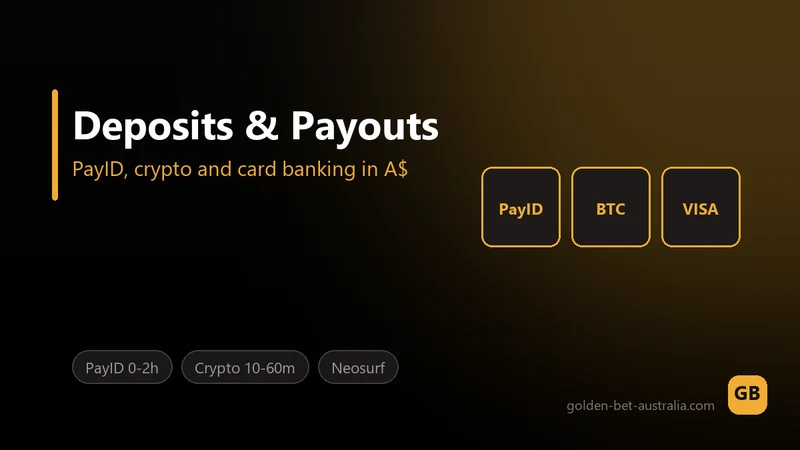
Deposit methods, minimums and how fast the balance updates
Confirmed methods at the time of our checks: PayID, Visa and Mastercard, Neosurf vouchers, cryptocurrency (BTC, ETH, LTC, USDT, USDC, XRP, Dash, Doge, TRX), the Skrill / Neteller / MiFinity e-wallet group, plus AstroPay, Interac and JetonBank, which appear as logos in the operator’s own footer. Availability shifts by region and by processor. The cashier you see after login is always the authority on what you can use today, and the list below is a snapshot of what was working during our own testing window. Methods drop off a list like this without anyone announcing it.
One clarification, because a lot of Australian casino guides copy this particular bit from each other. We could not confirm POLi as an available method at GoldenBet from any source, and we did not manage to use it ourselves either. If you want a bank-transfer style deposit without handing over card details, PayID is the route that worked for us.
| Method | Min deposit | Max deposit | Speed | Fee |
|---|---|---|---|---|
| PayID | A$20 | ~A$5,000 per transfer | Under 2 minutes in our runs | None from the cashier |
| Visa / Mastercard | A$30 | ~A$4,000 per transaction | Instant when the bank approves | None from the cashier; issuer may add a cash-advance charge |
| Neosurf voucher | A$10 | Voucher face value (commonly A$500) | Instant | None online; the retailer may charge on purchase |
| Crypto (BTC, ETH, LTC, USDT, USDC, XRP, Dash, Doge, TRX) | ≈A$25 equivalent | No practical cap we hit | 10–60 minutes, network dependent | Network fee only, paid to the blockchain |
| Skrill / Neteller / MiFinity | A$20 | ~A$5,000 per transaction | Instant | None from the cashier; wallet FX may apply |
| AstroPay / Interac / JetonBank | A$20 typical | Varies by processor | Minutes | None observed |
Figures come from our own deposits in July and August 2026 and from cross-checking two independent Australian review sites. Treat them as orientation and nothing firmer. An operator can raise a minimum overnight and has no obligation to announce it anywhere at all, which is why nothing on this page should be read as a published tariff.
PayID: why almost every Australian player ends up using it
PayID sits on the New Payments Platform, the real-time settlement network the big four and around eighty other Australian institutions plugged into from 2018. Instead of a BSB and account number, you register an identifier you already know by heart: a mobile number, an email address, or an ABN. Money then moves against that identifier in seconds, twenty-four hours a day, weekends included.
For casino deposits that matters twice over. The transfer settles fast enough that your balance is usable before you lose interest in the session you sat down to have, and no card number ever leaves your banking app. You are pushing money out of your own account instead of authorising a merchant to pull it in, which sidesteps the whole category of declined-card problems described further down this page.
Making a PayID deposit, step by step
- Log in and open the cashier, then pick PayID as the deposit method and enter the amount.
- The screen returns a PayID identifier and a unique reference code. Both matter, because the reference is how the processor matches your transfer back to your account.
- Switch to your banking app, choose “Pay someone”, select the PayID option and paste the identifier exactly as shown.
- Enter the same amount, paste the reference into the description field, and confirm.
- Your bank shows a confirmation name before you send. Read it. If nothing appears, or the screen looks wrong in any way, cancel and go back to the cashier for a fresh identifier.
Two habits saved us time here. Generate a fresh PayID identifier for every deposit instead of reusing a saved payee, because processors rotate them and an old one can route into a void. The second habit is duller and matters more: send the exact amount you entered in the cashier. A A$3 discrepancy turned one of our deposits into a manual reconciliation, and support needed forty minutes to clear it.
What PayID will not do for you
PayID transfers are effectively final. There is no chargeback mechanism the way there is with a Visa dispute, so the identifier you paste is the identifier that gets paid, and a typo becomes your problem rather than your bank’s. Scam operations built around fake casino cashiers exploit exactly that. It is why we only ever generate an identifier from inside a logged-in cashier session, never from an email and never from a chat message, however official the sender manages to look.
Deposit with PayIDNeosurf: the prepaid voucher for people who want distance from their bank
Neosurf is a paper voucher with a ten-digit code, sold at newsagents, service stations and convenience stores across Australia. Denominations usually start around A$10 and run up to A$500. You buy one with cash, type the code into the cashier, and the value shows up as balance a second later. Nothing hits your bank statement beyond a small retail purchase at a newsagent, which for some players is the entire point of using it.
The appeal is budget control. You cannot deposit money you did not physically walk into a shop and buy, which is a blunt ceiling but an effective one, and genuinely useful if you have ever chased a session with a second card. The trade-off is that vouchers only run one way. Money comes in through Neosurf and has to leave through something else, so nominate a second method before you ever need a payout. If bankroll control is the reason Neosurf appeals to you, the deposit limits and safer gambling tools in your account settings do the same job with less driving.
Treat the voucher like cash, because that is effectively what it is. Anyone who can read the code can spend it, so a photograph of one posted into a group chat should be written off as gone.
Crypto deposits, explained for someone who has never owned any
On the way out, crypto was the fastest method we tested. On the way in it was the one that made us read the screen twice, and almost all of that comes down to unfamiliar vocabulary rather than any real difficulty. Here is the whole process with the jargon stripped out.
Buying the coin
You need an account at an exchange that serves Australia. The mainstream ones support PayID or bank transfer for AUD deposits and run their own identity check before they let you buy anything, so budget a day for that verification the first time you go through it. For casino use, a stablecoin such as USDT or USDC is the sensible starting point: one unit tracks roughly one US dollar, so the value sitting in your casino balance is not drifting around underneath you while you play.
Choosing the network
This is the step that costs people money. A single coin can travel on several blockchains, and USDT exists on Ethereum, Tron, Solana and others. The casino cashier tells you which network its deposit address belongs to, and your exchange asks you to pick a network when you send. Those two have to match. Send Tron-network USDT to an Ethereum address and the funds land somewhere neither party can reach, at which point recovery ranges from expensive to flatly impossible.
Network choice also sets your fee. Sending USDT over Tron cost us well under a dollar and confirmed inside two minutes. The same transfer over Ethereum during a busy hour cost several dollars and sat there noticeably longer. When the cashier offers you a choice, the cheap fast network is almost always the right pick on a A$100 deposit, and the difference only stops mattering at sums most players never move.
Sending a test amount first
On any new address, send the minimum first. Wait for it to show up in your casino balance, then send the rest. The five minutes that costs you is cheap insurance against a typo buried in a forty-character string your eyes will happily skim straight over. After the first successful transfer the address is saved at your exchange, and repeat deposits take under a minute from then on.
What confirmations mean
Your transfer appears on the blockchain immediately and gets credited after a set number of confirmations, which simply means blocks added after yours. Bitcoin typically wants a handful of them and therefore takes longer than the coins built for speed; Litecoin, Tron and the stablecoins running on them clear far quicker. A deposit showing as “pending confirmations” is working normally. Support cannot speed it up either, because the delay lives out on the network rather than anywhere inside the cashier.
Fund your account in cryptoCards, declined transactions and MCC 7995
Visa and Mastercard deposits did work for us. The decline rate was noticeably higher than on any other method though, and the reason for that sits with your bank rather than with the casino.
Why the bank sometimes refuses
Every merchant carries a four-digit merchant category code. Gambling transactions are coded 7995, and Australian card issuers treat that code with suspicion as a matter of policy. Credit cards are the strictest case: since June 2023 the National Consumer Credit Protection Amendment blocks credit-card use for online wagering with Australian-licensed operators, and most issuers apply a blanket 7995 block rather than sorting one merchant from another. Debit cards get through more often. Individual banks still run their own rules on top of that, and several offer a gambling-block toggle inside the banking app, although plenty of people only discover the toggle because it was already switched on by default.
A declined card is rarely something you can argue your way past. Calling the bank tends to produce a polite restatement of the policy that declined you in the first place, and the person on the line has no button to override it. Switching to PayID takes about ninety seconds and ends the conversation.
What appears on your statement
Offshore casino processors almost never bill under the brand name you played on. The descriptors we saw were neutral payment-services labels with a foreign city attached, which is standard practice for the acquiring banks that handle this kind of traffic. Here is why that is worth knowing in advance. An unfamiliar descriptor is easy to misread as fraud, and disputing your own deposit with the bank triggers a chargeback that will freeze the casino account and can void a bonus along with it. Keep a note of what you deposited and when. If you also intend to claim the welcome offer, read the bonus wagering requirements before you fund the account, because deposit method occasionally affects eligibility.
E-wallets and the remaining options
Skrill, Neteller and MiFinity behave as a middle layer: you fund the wallet from a card or a bank transfer, then push money to the casino out of the wallet. Deposits are instant, and withdrawals back to the wallet were consistently faster than card refunds across our runs, usually inside a day. The catch is currency. Wallets often hold balances in USD or EUR, and every hop between currencies takes a spread of a few percent that nobody itemises for you anywhere.
AstroPay, Interac and JetonBank appear in the operator’s own footer. AstroPay works as a prepaid-style card issued inside its own app. Interac is a Canadian bank-transfer rail, and Australians rarely have access to it in the first place. JetonBank comes from the same family as Jeton and behaves like any other wallet. For an Australian player, all three are situational fallbacks you reach for once something better has already failed.
Withdrawals: what we actually measured
Payout speed is where operators separate from one another. Cashier processing time is only one component of it, and in practice the operator’s own review queue and your verification status decide far more of the outcome than the rail you picked.
| Method | Min withdrawal | Processing time | Fee | Notes |
|---|---|---|---|---|
| Crypto (USDT, LTC, BTC and others) | ≈A$30 equivalent | 10–60 minutes after approval | Network fee only | Fastest option in every test; network must match the receiving wallet |
| PayID | A$20 | 0–2 hours after approval | None | Lands in an Australian bank account, weekends included |
| Skrill / Neteller / MiFinity | A$20 | Up to 24 hours | None from the cashier | Wallet-to-bank transfer adds a day and a currency spread |
| Visa / Mastercard | A$30 | 2–5 business days | None from the cashier; issuer may charge | Returns to the card that funded the deposit; weekends do not count |
| Neosurf | — | — | — | Deposit only; nominate an alternative before requesting a payout |
The bars show typical hours from approval to funds received, and every one of them assumes an account that is already verified. On an unverified account the honest number for all four methods is “however long the document check takes”, and that figure dwarfs everything else on the chart by a wide margin.
Verification before your first payout
The first withdrawal request is when the compliance layer wakes up. Curaçao-licensed operators carry anti-money-laundering obligations, and the standard package is proof of identity plus proof of address plus proof of payment method: a passport or driver licence, a utility bill or bank statement dated within the last three months showing the same name and address, and a partly masked image of the card you deposited with. Deposit by PayID or crypto and that third item usually drops off the list on its own.
Turnaround in this market sits around 24 to 48 hours when the documents are clean. What makes them unclean is depressingly predictable: a photo with a cropped corner, a screenshot of a banking app instead of a downloaded statement, a mobile phone bill for an address that no longer matches the account, glare sitting across the licence number. Each rejection restarts the clock from zero.
The obvious move is to verify on day one rather than on payout day. Upload everything right after you open a GoldenBet account and the first withdrawal skips the queue entirely. We explain the document rules and the reasoning behind them in more depth in our guide to why casinos require ID verification.
The real reasons a withdrawal sits pending
Support tickets about slow payouts almost always trace back to one of these:
- Verification incomplete. The request queues silently until documents clear. Check your account status before you assume anything has gone wrong.
- Bonus wagering unfinished. An active bonus locks the balance. With a 45x wagering requirement and a A$500 conversion cap, what you can actually cash out is set by the bonus terms rather than by the number showing on screen.
- Withdrawing to a method you never deposited with. AML rules push funds back down the path they came in on. A payout to a fresh account or wallet gets flagged for manual review.
- Name mismatch. The bank account, the ID and the casino profile all need the same legal name. A shortened first name is enough to stall the lot.
- Weekend and pending windows. Many operators hold requests for a fixed review period before processing them, and card refunds only move on business days. A Friday-night request that arrives Wednesday has usually behaved exactly as designed.
- An oversized request. Ask for more than the per-request cap and the cashier may split it across several payments instead of rejecting it outright.
You can cancel a pending withdrawal and put the money back in play at most casinos. That feature exists because it earns money on the operator’s side of the ledger, and simply leaving a pending payout alone will do more for your bankroll than any strategy article you will ever read. If you catch yourself reversing withdrawals repeatedly, that is the cue to set a cooling-off period. Switching to a faster payment rail does nothing to the habit underneath it.
Check current payment optionsLimits by day, week and month
Three separate ceilings apply, and most players only discover the second and third at an awkward moment. The per-request cap runs around A$5,000 on most methods. Above that sits a weekly ceiling, with figures in this market clustering around A$10,000, and above that a monthly one that commonly lands between A$30,000 and A$40,000. Under rules like those, a large win gets paid out in instalments across several weeks. That is normal practice for offshore operators and it is written into the terms, whether or not anyone reads them.
VIP tiers raise the ceilings. Progressive jackpot wins are typically carved out and paid under separate terms of their own. If you are ever sitting on a five-figure balance, message support before requesting anything and get the payment schedule in writing. Waiting a day for that answer beats spending a fortnight guessing at how the instalments will fall.
Account currency and the cost of conversion
Open the account in AUD if the option is offered. Every conversion between currencies takes a margin, and those margins compound in ways that are easy to miss: your bank converts AUD to USD when you fund an e-wallet, the wallet converts again when it pays the casino, and the return trip repeats both of those steps. Three to five percent can evaporate on a round trip without a single fee line appearing anywhere on a statement.
Crypto has the same problem wearing a different costume. Buying USDT with AUD carries a spread at the exchange, and selling it back carries another one. Stablecoins take the price volatility out of the middle of that sandwich, which is why we prefer them to Bitcoin for casino balances, but both conversion points stay exactly where they were. Playing in AUD through PayID is the only path with no conversion at all, and that is a large part of why it dominated our own deposit mix. Balances also carry across devices without any extra step, so a deposit made on desktop is available immediately if you switch to the GoldenBet mobile web app mid-session.
Tax on gambling winnings in Australia
What follows is general information rather than tax advice. For your own situation, talk to a registered tax agent or check the ATO directly.
The long-standing Australian position is that gambling winnings for a recreational player are not treated as assessable income, because the activity is regarded as a pastime whose outcome turns on chance rather than as a business or a profession. Losses cannot be deducted for exactly the same reason. The ATO has historically applied this to casino play, wagering and lotteries alike, and the same logic covers wins on real-money pokies at GoldenBet as it does a race bet.
The exception involves people who gamble as a business. Those are the rare cases where the activity is systematic, organised and pursued for profit in a way a court would recognise as carrying on an enterprise, and the bar sits high enough that very few players go anywhere near it. Separately, interest earned on winnings sitting in a savings account is ordinary income and is assessable in the usual way.
Keep records regardless. Large or frequent bank movements attract questions from banks under their own AML obligations, and a tidy record of deposits and withdrawals answers those questions in a single email instead of a fortnight of correspondence.
Payment questions we hear most
How fast is a PayID withdrawal in practice?
Somewhere between minutes and a couple of hours, once the account is verified and the request has cleared the operator’s review window. The transfer leg itself is near-instant on the NPP, so anything longer than that is the casino-side queue rather than your bank being slow.
Is there a fee on deposits or withdrawals?
We were not charged a cashier fee on any method. The costs that did appear came from elsewhere: blockchain network fees on crypto, currency spreads through e-wallets, and whatever an individual card issuer decides to apply to a gambling transaction on the day.
Can I deposit with one method and withdraw to another?
Usually only after the original method has been refunded up to the deposited amount, which is a standard anti-money-laundering control rather than an operator quirk. Profit above that line can generally go to an alternative method you have verified.
Why was my card declined when the casino says cards are accepted?
The decline came from your issuer. The cashier is only reporting back what the bank told it. Australian banks block MCC 7995 traffic on credit cards as a matter of policy, and many apply gambling blocks to debit cards too. PayID avoids the whole question.
Does the operator accept POLi?
We could not confirm POLi as an available method and would not plan around it. PayID covers the same need: a transfer straight out of your bank account without exposing card details to anyone.
What happens if I send crypto on the wrong network?
The funds leave your wallet and arrive at an address nobody controls on that chain. Recovery is sometimes possible and always slow. Matching the network on both sides and sending a test amount first prevents it entirely.
Where this leaves an Australian player
PayID in, crypto out produced the fewest surprises across our testing: no card declines, no conversion spread on the way in, and payouts measured in minutes once the account was verified. Cards work when your bank allows them, and on the return leg they behave like a slow bank transfer. Neosurf earns its place mainly as a spending cap you enforce with your own feet. Our broader assessment of the operator, covering licensing, the game library, support responsiveness and the caveats that come with an offshore Curaçao licence, sits in the full GoldenBet Australia review and verdict.
Gambling is 18+, and every method on this page moves real money that you should be prepared to lose. Set a deposit limit before your first transfer, while the decision is still an abstract one. Free, confidential help is available around the clock through Gambling Help Online on 1800 858 858 or at gamblinghelponline.org.au.
Claim the welcome offerHow we timed the payouts
We funded a live account five separate times between 8 July and 4 August 2026: twice by PayID, then once each by card, by USDT on the Tron network, and with a A$50 Neosurf voucher. A withdrawal followed every session. Timing started when the confirmation screen appeared and stopped when the funds were genuinely spendable in the receiving account or wallet, so operator review time, weekend queues and network confirmations are all counted in rather than quietly stripped out to flatter the numbers. The account was fully verified before the second deposit, which is why the first payout took materially longer and is reported separately in our notes. Amounts were kept small and deliberately unremarkable, because a A$40 withdrawal and a A$4,000 one do not travel through the same review path. Limits, minimums and processing windows shift without notice, so check the cashier before you commit to anything. Our figures describe what we measured across those five runs and nothing beyond that.